
HR Services in Spain
HR support for US, UK and international companies hiring in Spain: Spanish contracts and policies, payroll coordination, compliance and recruitment. Build your Spanish team without building an HR department first.

Last reviewed October 2026. Collective agreements can set higher standards.
Expand Into Spain With an HR Partner Who Knows Spanish Labor Law
Spain is the EU’s fourth-largest economy and grew 2.6% in 2025, the fastest of the EU’s four largest. It also brings detailed employment rules: contracts presumed permanent, two extra payments a year, set severance on dismissal, employee representatives that staff can elect from 11 employees, and collective agreements that bind every employer in their scope.
Europe HR Solutions is your HR partner for Spain. We prepare Spanish contracts, policies and handbooks, put payroll foundations in place and coordinate your payroll provider, support hiring and reward, and review your HR practices as Spanish law changes.
Expanding beyond Spain? The same team covers 27+ European countries, so you manage one relationship instead of a provider in every market.
On this page
Tell us about your plans for Spain. We’ll tell you honestly what we see.
Book a Free Consultation Free, no commitment.HR Outsourcing in Spain With Europe HR Solutions
One senior Europe HR Solutions team coordinates your HR in Spain, working with independent in-country HR professionals from our European network who understand Spanish employment practice.
Everyday HR, handled
Payroll coordination, recruitment, compliance and employee relations for your team in Spain, handled as one service, so you can focus on growing the business.
Compliance with Spanish labor law
We make sure your HR operations comply with Spanish law, and review your contracts and policies as statutory rules and collective agreements change.
Cost-effective HR
Outsourcing means you don’t need your own HR team in Spain, which reduces cost and frees resources for growth.
Flexible engagement
We work ad hoc, on an interim basis, by project or on a retainer, from a few weeks to several years.
HR Services We Provide in Spain
Each of our services is available for Spain.
Compliant contracts, payroll registration and statutory foundations in place before your first Spanish hire.
Employment Documentation Package→Spanish contracts, policies and handbooks aligned with Spanish labor law.
Systems & Payroll Coordination→Your HR systems and payroll providers aligned, with consistent data and full visibility for leadership.
Compensation & Benefits Strategy→A structured reward framework aligned with Spanish law, market data and internal equity.
Recruitment Support→Roles calibrated, salaries benchmarked and hiring aligned with Spanish employment law.
HR Compliance Audit→A structured review of your HR compliance risk in Spain, with a clear action plan.
Retained HR Services→Ongoing senior HR oversight on a monthly retainer, including manager coaching and support with works council interactions.
M&A HR Support→HR due diligence, employee transfer and post-deal integration for deals in Spain.
Key Employment Regulations in Spain
The Workers’ Statute (Estatuto de los Trabajadores) sets the baseline. Collective agreements can add to it, so check both before you hire.
Show all 12 regulationsHide the regulations
Contracts and written terms
Contracts are presumed permanent. Fixed-term, part-time, remote and several other contracts must be in writing, or they’re presumed permanent and full-time. For jobs over 4 weeks, the main terms must be in writing before work starts, and every employee is registered with Social Security before day one.
Working hours and time records
Ordinary hours average up to 40 a week over the year, with no more than 9 a day unless a collective or workplace agreement says otherwise, and 12 hours’ rest between working days. Paid overtime is capped at 80 hours a year. Employers record each employee’s daily start and finish times and keep them 4 years.
Minimum wage and extra payments
€1,221 a month in 14 payments, or €40.70 a day, for 2026 (€17,094 a year), applying from January 1. Employees are also entitled to two extra payments a year, one at Christmas; the collective agreement sets the amount and can spread them over 12 months.
Paid leave and public holidays
At least 30 calendar days a year of paid leave, which can’t be swapped for money during employment. Up to 14 paid public holidays a year, 2 of them local. Weekly rest is at least a day and a half.
Sick pay (incapacidad temporal)
For common illness, Social Security pays 60% of the benefit base from day 4 to day 20 and 75% from day 21; the employer pays days 4 to 15. The first 3 days carry no statutory benefit. For work accidents, 75% applies from the day after.
Birth and parental leave
Each parent gets 19 weeks of birth leave, paid at 100% of the benefit base: 6 mandatory weeks after the birth, 11 within the first year and 2 usable until age 8. Single parents get 32. A further 8 weeks of parental leave can be taken until the child turns 8.
Probation (periodo de prueba)
Probation must be agreed in writing. Without a collective agreement limit, it lasts up to 6 months for qualified technical staff and 2 months for others (3 in companies under 25 employees), and 1 month in fixed terms of 6 months or less.
Dismissal (despido)
Dismissal must be in writing with its reasons. Objective dismissals, such as for economic reasons, need 15 days’ notice and 20 days’ salary per year of service, up to 12 months. An unfair dismissal means reinstatement or 33 days’ salary per year, up to 24 months. Senior executives (alta dirección) have their own rules.
Employee representatives
Workplaces with 11 to 49 employees can elect staff delegates (delegados de personal), and those with 6 to 10 if most staff agree; from 50, a works council (comité de empresa). Elections are called by unions or by a staff majority. Representatives receive a basic copy of written contracts.
Collective agreements (convenios colectivos)
Collective agreements made under the Workers’ Statute bind every employer and employee within their scope for as long as they’re in force. They set the amount of the extra payments and can change probation limits.
Social security
Non-wage costs, such as employer social contributions, make up 26.2% of total labor costs in Spain, or about 35% on top of gross wages (Eurostat, 2025).
Pay transparency
Spain missed the June 2026 deadline for the EU Pay Transparency Directive, and the Labor Ministry published a draft decree in August 2026. Already, every employer must keep a pay register by sex, and companies with 50 or more employees need an equality plan.
The Benefits of Expanding to Spain
What Spain offers companies that set up properly.
Growth
Spain’s economy grew 2.6% in 2025, the fastest of the EU’s four largest economies and above the EU’s 1.4% (Eurostat).
A major EU economy
Spain is the EU’s fourth-largest economy, with GDP of €1.69 trillion in 2025 (Eurostat).
A large market
Spain has 49.6 million people, the fourth-largest population in the EU (Eurostat, January 1, 2026).
Scientists and engineers
Spain has 1.8 million employed scientists and engineers, the third most in the EU (Eurostat, 2025).
Exports
Spanish goods exports reached €387 billion in 2025, the second-best year on record (Ministry of Economy, Trade and Business).
Software investment
Spain ranks 2nd of 139 economies for software spending as a share of GDP (Global Innovation Index 2026).
The Challenges of Expanding to Spain
Six things to plan for before your first hire.
Contracts presumed permanent
Fixed terms are only allowed for production needs, up to 6 months (1 year under a sector agreement), or to replace an employee.
Employment costs
Non-wage costs add about 35% on top of gross wages (Eurostat, 2025), plus two extra payments a year.
Severance on dismissal
Objective dismissals cost 20 days’ salary per year of service, and unfair ones 33 days, up to 24 months.
Collective agreements
A collective agreement made under the Workers’ Statute binds every employer in its scope, whether or not you signed it.
Daily time records
Employers must record each employee’s start and finish times every day and keep the records for 4 years.
Spanish and regional languages
Spanish is the official language of the state, and other languages are co-official in some regions, so plan for them in official dealings.
Key HR Compliance Risks in Spain
Eight mistakes to avoid in Spain, and what each one leads to.
Employee not registered
Failing to register an employee with Social Security before they start is a serious offense, fined from €751 to €7,500 per worker.
Null dismissal
Dismissing an employee who is pregnant or on birth or parental leave, or for discriminatory reasons, is void: immediate reinstatement with back pay.
Fixed terms misused
A fixed term that breaks the rules makes the employee permanent, as do more than 18 months within 24 on production contracts.
Unfair dismissal
If a court rules a dismissal unfair, the employee is reinstated or paid 33 days’ salary per year of service, up to 24 months.
Contract not in writing
Where a contract must be in writing and isn’t, it’s presumed permanent and full-time.
No daily time records
Daily start and finish times must be kept for 4 years and be available to the labor inspectorate.
Probation not valid
Probation not agreed in writing, or for a job the employee has already done in the company, isn’t valid.
Leave paid out instead of taken
Paid leave can’t be swapped for money during employment, so the 30 or more calendar days must actually be taken.
Not sure where you stand? Our HR Compliance Audit gives you a structured review of your HR compliance risk in Spain, with a clear action plan.
Key Sectors in Spain
Spain’s leading export sectors in 2025, based on Eurostat trade data.
Free HR Guide for Spain
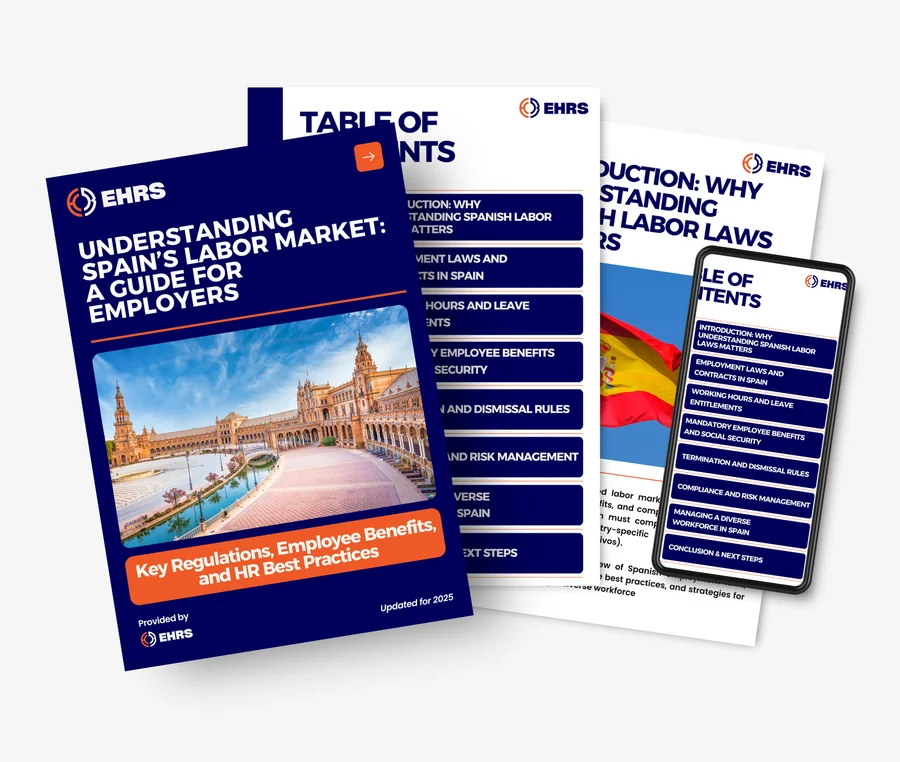
Understanding Spain’s Labor Market: A Guide for Employers
Key regulations, employee benefits, and HR best practices.
Want to read more first? See our article on Spanish labor laws, employee benefits and compliance.
Hiring in Spain: Your Questions Answered
Questions companies ask before they hire in Spain.
Do we need written employment contracts in Spain?
Fixed-term contracts over 4 weeks, part-time, remote and several other contracts must be in writing, or they’re presumed permanent and full-time. For any job over 4 weeks, the main terms must be in writing before work starts. You also register the employee with Social Security before day one and report the contract to the public employment service within 10 days. We draft contracts that comply with Spanish law.
Can we let someone go in Spain if they don’t work out?
During a written probation period, either side can end the contract. Without a collective agreement limit, it lasts up to 6 months for qualified technical staff and 2 months for others (3 in companies under 25 employees). Ending it because of pregnancy is void. After probation, dismissal needs objective or disciplinary grounds. We make sure your contracts include a clear probation period.
How much does an employee in Spain cost on top of salary?
Non-wage costs, such as employer social contributions, add about 35% on top of gross wages (Eurostat, 2025). Employees are also entitled to two extra payments a year, and the employer pays sick leave from day 4 to day 15. Our Compensation & Benefits Strategy builds a reward framework aligned with Spanish law, market data and internal equity.
How many hours can staff in Spain work?
Ordinary hours average up to 40 a week over the year, with no more than 9 a day unless a collective or workplace agreement says otherwise, and 12 hours’ rest between working days. Overtime is paid at least at the ordinary rate or compensated with paid rest, and paid overtime is capped at 80 hours a year. We structure work schedules that comply and still leave room for flexibility.
What happens when an employee in Spain is off sick?
For common illness, Social Security pays 60% of the benefit base from day 4 to day 20 and 75% from day 21, with the employer paying days 4 to 15. The first 3 days carry no statutory benefit. For work accidents, 75% applies from the day after, and the employer pays the day of the accident in full. We put clear sick leave policies in place.
How much paid leave do employees in Spain get?
At least 30 calendar days a year, which can’t be swapped for money during employment, plus up to 14 paid public holidays, 2 of them local. Employees must know their leave dates at least 2 months in advance. We keep you compliant with leave entitlements and help you offer a competitive benefits package.
Is it really that hard to terminate employees in Spain?
It’s strict, not impossible. Dismissal must be in writing with its reasons. Objective dismissals need 15 days’ notice and 20 days’ salary per year of service, up to 12 months. If a court rules a dismissal unfair, you choose reinstatement or 33 days’ salary per year, up to 24 months, with more for service before February 2012; workers’ representatives make that choice themselves. Dismissal during pregnancy or birth leave is void. We guide you through every step.
Can we put everyone on fixed-term contracts in Spain?
No. Contracts are presumed permanent, and a fixed term is only allowed for production needs, up to 6 months (1 year under a sector agreement), or to replace an employee, with the reason stated precisely. More than 18 months within 24 on two or more production contracts makes the employee permanent, as does breaking these rules. We make sure every fixed-term contract meets these rules.
Do collective agreements apply to us in Spain?
If your business falls within one’s scope, yes. Collective agreements made under the Workers’ Statute bind every employer and employee they cover, set the amount of the two extra payments and can change probation limits. We keep you compliant with any agreement that applies, with as much flexibility as it allows.
Do we need employee representatives in Spain?
Not automatically. Unions or a majority of staff can call elections: staff delegates in workplaces with 11 to 49 employees (6 to 10 if most agree) and a works council from 50. Representatives receive a basic copy of written contracts. We guide you in working with employee representatives.
What does pay transparency mean for us in Spain?
Spain missed the June 2026 deadline for the EU Pay Transparency Directive, and the Labor Ministry published a draft decree in August 2026. Already, every employer must keep a pay register with average pay by sex, and companies with 50 or more employees need an equality plan. Our Compensation & Benefits Strategy covers EU Pay Transparency readiness.
What happens if we fail a labor inspection in Spain?
Failing to register an employee with Social Security before they start is a serious offense, fined from €751 to €7,500 per worker. Inspectors can also review the daily time records you must keep for 4 years. We conduct regular compliance audits so your documentation is ready for inspection.
Plan Your Spanish Expansion With an HR Specialist
Tell us about your plans for Spain, whether it’s your first hire or a growing team. We’ll tell you honestly what we see.
- Spain and 27+ European countries, through one team.
- No commitment, no generic pitch.
New to working with us? See how we work, from the first call to ongoing support.
What happens next: a senior consultant reads your message and replies within one business day to set up a short call.