HR Services in Switzerland
HR support for US, UK and international companies hiring in Switzerland: Swiss contracts and policies, payroll coordination, compliance and recruitment. Build your Swiss team without building an HR department first.

Last reviewed October 2026. Collective agreements can set other terms.
Expand Into Switzerland With an HR Partner Who Knows Swiss Labor Law
Switzerland has topped the Global Innovation Index every year from 2020 to 2026, and its goods exports reached €311.7 billion in 2025, excluding gold and other precious metals. It also brings its own employment rules: no national minimum wage but local ones in five cantons and the city of Lucerne, weekly hour limits, sick pay that grows with service, protected periods when you can’t give notice, and employee committees from 50 employees.
Europe HR Solutions is your HR partner for Switzerland. We prepare Swiss contracts, policies and handbooks, put payroll foundations in place and coordinate your payroll provider, support hiring and reward, and review your HR practices as Swiss law changes.
Expanding beyond Switzerland? The same team covers 27+ European countries, so you manage one relationship instead of a provider in every market.
On this page
Tell us about your plans for Switzerland. We’ll tell you honestly what we see.
Book a Free Consultation Free, no commitment.HR Outsourcing in Switzerland With Europe HR Solutions
One senior Europe HR Solutions team coordinates your HR in Switzerland, working with independent in-country HR professionals from our European network who understand Swiss employment practice.
Everyday HR, handled
Payroll coordination, recruitment, compliance and employee relations for your team in Switzerland, handled as one service, so you can focus on growing the business.
Compliance with Swiss labor law
We make sure your HR operations comply with Swiss law, and review your contracts and policies as federal and cantonal rules and collective agreements change.
Cost-effective HR
Outsourcing means you don’t need your own HR team in Switzerland, which reduces cost and frees resources for growth.
Flexible engagement
We work ad hoc, on an interim basis, by project or on a retainer, from a few weeks to several years.
HR Services We Provide in Switzerland
Each of our services is available for Switzerland.
Compliant contracts, payroll registration and statutory foundations in place before your first Swiss hire.
Employment Documentation Package→Swiss contracts, policies and handbooks aligned with Swiss labor law.
Systems & Payroll Coordination→Your HR systems and payroll providers aligned, with consistent data and full visibility for leadership.
Compensation & Benefits Strategy→A structured reward framework aligned with Swiss law, market data and internal equity.
Recruitment Support→Roles calibrated, salaries benchmarked and hiring aligned with Swiss employment law.
HR Compliance Audit→A structured review of your HR compliance risk in Switzerland, with a clear action plan.
Retained HR Services→Ongoing senior HR oversight on a monthly retainer, including manager coaching and support with employee representative interactions.
M&A HR Support→HR due diligence, employee transfer and post-deal integration for deals in Switzerland.
Key Employment Regulations in Switzerland
Federal law sets the baseline, mainly the Code of Obligations and the Labor Act. Cantonal rules and collective agreements can add to it, so check all three before you hire.
Show all 12 regulationsHide the regulations
Contracts and written terms
As a rule, a contract needs no written form. But if it’s open-ended or longer than a month, you must confirm the parties, start date, role, pay and weekly hours in writing within a month of the start. Some terms only apply if agreed in writing, such as a longer probation, different notice periods or excluding the overtime premium.
Working hours and overtime
The Labor Act caps the week at 45 hours for industrial, office, technical and other salaried staff, including large-store sales staff, and 50 for others, with 11 hours’ daily rest. Overtime above that is limited to 2 hours a day, with exceptions, and 170 or 140 a year. Extra hours earn 25% more unless offset by agreed time off or, within limits, excluded in writing.
Minimum wage and sector pay
There’s no general national minimum wage. Five cantons and the city of Lucerne set one by law, such as Geneva’s general rate of CHF 24.59 an hour in 2026 (CHF 24.73 from 2027). Collective agreements and some standard employment contracts set sector minimums.
Paid leave and public holidays
At least 4 weeks a year, or 5 weeks up to age 20, on full pay, with at least 2 weeks in a row; leave can’t be paid out while employment lasts. August 1 is the paid federal holiday, and each canton can add up to 8 more public holidays treated like Sundays.
Sick pay
If employment has lasted, or was agreed for, more than 3 months, the employer pays full salary for 3 weeks in service year 1, then longer as service grows, unless a written or collective agreement sets an at least equivalent scheme. No federal law requires daily sickness insurance, but employers very often take it out, and most collective agreements require it.
Maternity and other-parent leave
Maternity leave is at least 14 weeks; eligible mothers get 80% of earnings, up to CHF 220 a day, from income compensation insurance (EO) and may not work for 8 weeks after birth. The other parent gets 2 weeks within 6 months, paid the same way. Parents of a seriously ill child can share up to 14 weeks of care leave.
Probation (Probezeit / temps d’essai)
The first month is probation by default. A written agreement, standard employment contract or collective agreement can change it, up to 3 months. Either side can end the contract during probation with 7 days’ notice, and probation is extended by time lost to illness, accident or a legal duty.
Notice and dismissal (Kündigung / résiliation)
After probation, notice is 1 month in year 1 of service, 2 months in years 2 to 9 and 3 months after, to a month’s end. Changes need writing, can’t go below 1 month (except by collective agreement in year 1) and, as a rule, must be equal for both sides. Notice you give in protected periods, such as illness or pregnancy, is void; an abusive dismissal can cost up to 6 months’ pay.
Employee representatives
In establishments with at least 50 employees, staff can elect an employee committee; a vote must be held if a fifth ask, or 100 where there are over 500. It must be informed at least yearly and has participation rights on safety, business transfers, mass redundancies and the pension fund. Without a committee, employees hold these rights directly.
Collective agreements (GAV / CCT)
Collective employment agreements are concluded between employers or their associations and unions. One binds you if you or your association signed it, or you joined it with the parties’ consent. Its terms on hiring, content and ending of employment then apply directly to your contracts: a clause that gives an employee less is void and replaced by the agreement’s term; more generous clauses stand. On the parties’ request, the Federal Council, or a canton for an agreement limited to its territory, can declare an agreement generally binding, which extends it to every employer in that sector or trade, signatory or not.
Social security
In 2026, employers pay 5.3% for AHV/IV/EO and 1.1% for unemployment insurance up to CHF 148,200 a year, matching employees, plus occupational accident insurance, cantonal family allowance contributions and at least the employees’ total into the occupational pension (BVG) for employees earning over CHF 22,680 a year (CHF 23,040 from 2027). Non-wage costs add about 25% to wages (Federal Statistical Office, 2020).
Pay transparency
Outside the EU, Switzerland isn’t bound by its Pay Transparency Directive. Under the Gender Equality Act, employers with 100 or more employees (apprentices not counted) must as a rule run an equal pay analysis, have it checked independently and tell staff the result within a year of the check; those that pass needn’t repeat it. Rules run until June 30, 2032.
The Benefits of Expanding to Switzerland
What Switzerland offers companies that set up properly.
The most innovative economy
Switzerland ranks 1st of 139 economies in the Global Innovation Index 2026, and has every year from 2020 to 2026 (WIPO).
A high-value economy
Switzerland’s GDP was €925.9 billion in 2025, for a population of 9.1 million (Eurostat; Federal Statistical Office).
Exports
Goods exports reached €311.7 billion in 2025, excluding gold and other precious metals; 52.3% were chemicals and pharmaceuticals (Eurostat).
R&D investment
Switzerland invested CHF 25.9 billion in R&D in 2023, 3.2% of GDP, 69% of it by private companies (Federal Statistical Office).
University-industry research
Switzerland ranks 3rd of 139 economies for university-industry R&D collaboration (Global Innovation Index 2026).
Knowledge-intensive jobs
52.6% of employment in Switzerland is knowledge-intensive, 7th of 139 economies (Global Innovation Index 2026).
The Challenges of Expanding to Switzerland
Six things to plan for before your first hire.
Pay floors by sector and place
Pay floors come from your sector’s collective agreement, some standard employment contracts and, in five cantons and the city of Lucerne, local law.
Employment costs
Non-wage costs add about 25% to gross wages (Federal Statistical Office, 2020), mostly employer contributions to AHV/IV/EO, unemployment, accident and pension insurance and family allowances.
26 cantons
Public holidays, family allowances and some minimum wages differ by canton, and cantonal authorities enforce the Labor Act.
Language regions
German, French and Italian each have their own regions, and cantons set their official languages, so plan HR documents for each site.
Sick pay that grows with service
Salary continues for longer as service grows, unless an equivalent scheme, such as daily sickness benefit insurance, is agreed in writing.
Protected periods
After probation, notice you give during illness (30 to 180 days, by service), pregnancy or the 16 weeks after birth is void.
Key HR Compliance Risks in Switzerland
Eight mistakes to avoid in Switzerland, and what each one leads to.
Notice in a protected period
After probation, notice you give during an employee’s illness or injury (30, 90 or 180 days, by service), pregnancy or the 16 weeks after birth is void, and notice already running pauses.
Abusive dismissal
Dismissal over a personal characteristic, good-faith claims or union activity is abusive and can cost up to 6 months’ pay, if the employee objects in writing before notice ends.
Dismissal without notice
An immediate dismissal without good cause entitles the employee to pay until normal notice would have ended, plus compensation of up to 6 months’ pay.
Accident insurance missing
Employees must be insured against accidents, with occupational premiums paid by you. Without cover, you owe replacement premiums for up to 5 years, doubled if inexcusable and up to 10 times if repeated.
Overtime premium not excluded in writing
Extra hours earn 25% more unless offset by agreed time off. Only a written, standard or collective agreement can exclude this, never above the Labor Act’s weekly cap (office staff: from the 61st such hour yearly).
Working time not recorded
Records of daily and weekly hours, including overtime, must be kept for 5 years, with limited exceptions. Inspectors can order compliance under threat of a criminal penalty.
Mass redundancy without consultation
Dismissing 10 or more for reasons unrelated to the employees within 30 days in an establishment of over 20 staff (more in larger ones) requires consulting staff and notifying the cantonal labor office; without consultation, each can cost up to 2 months’ pay.
Contributions not paid
Unpaid AHV contributions can be claimed for 5 years after the year they were due, and employers are liable for losses caused intentionally or through gross negligence.
Not sure where you stand? Our HR Compliance Audit gives you a structured review of your HR compliance risk in Switzerland, with a clear action plan.
Key Sectors in Switzerland
Switzerland’s leading export sectors in 2025, based on Eurostat trade data, excluding gold and other precious metals.
Free HR Guide for Switzerland
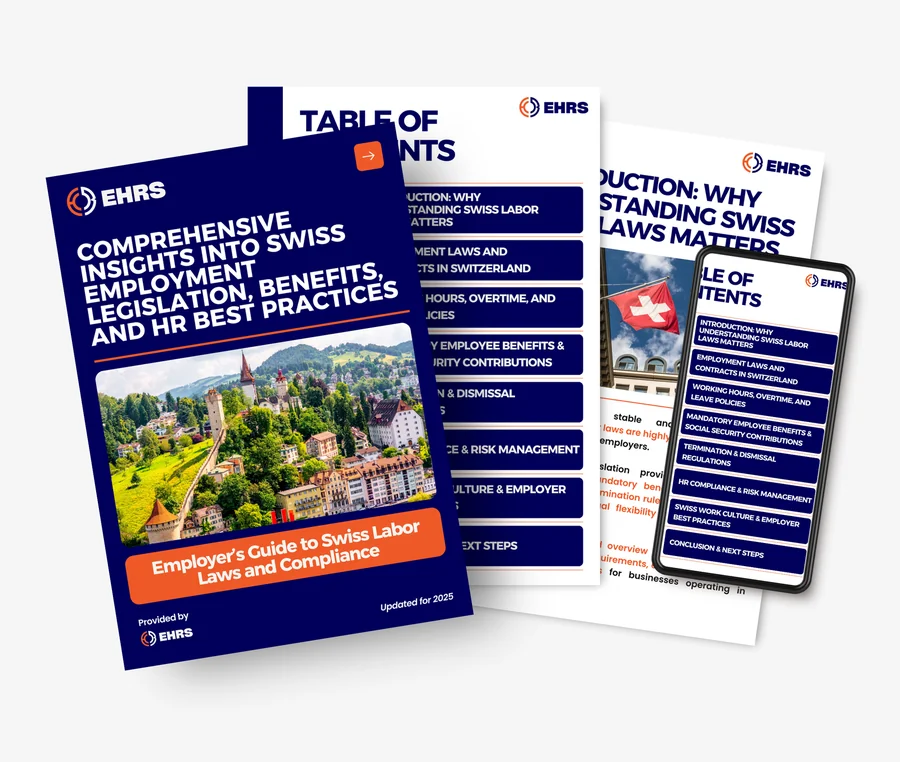
Comprehensive Insights into Swiss Employment Legislation, Benefits, and HR Best Practices
Employer’s guide to Swiss labor laws and compliance.
Want to read more first? See our article on HR and compliance in Switzerland.
Hiring in Switzerland: Your Questions Answered
Questions companies ask before they hire in Switzerland.
Do we need written employment contracts in Switzerland?
Not as a rule. A contract is valid without written form, but if it’s open-ended or longer than a month, you must confirm the parties, start date, role, pay and weekly hours in writing within a month of the start. Some terms only apply if agreed in writing, such as a longer probation, different notice periods or excluding the overtime premium. We draft contracts that comply with Swiss law.
Is there a probation period in Switzerland?
Yes. The first month is probation by default, and a written agreement, standard employment contract or collective agreement can change it, up to 3 months. Either side can end the contract during probation with 7 days’ notice, and probation is extended by time lost to illness, accident or a legal duty. We make sure your contracts reflect these rules.
How much does an employee in Switzerland cost on top of salary?
Non-wage costs, such as employer social contributions, add about 25% to gross wages (Federal Statistical Office, 2020). In 2026, employers pay 5.3% for AHV/IV/EO and 1.1% for unemployment insurance up to CHF 148,200, plus accident insurance, family allowances and at least the employees’ total into the occupational pension for employees earning over CHF 22,680 a year (CHF 23,040 from 2027). Our Compensation & Benefits Strategy builds a reward framework aligned with Swiss law, market data and internal equity.
How many hours can staff in Switzerland work?
Up to 45 hours a week for industrial, office, technical and other salaried staff, including sales staff in large retail, and 50 hours for others, with 11 hours’ rest a day. Overtime above these limits is capped at 2 hours a day, with exceptions, and 170 or 140 hours a year. Senior executives fall outside the Labor Act. We structure work schedules that comply and still leave room for flexibility.
What happens when an employee in Switzerland is off sick?
If employment has lasted, or was agreed for, more than 3 months, you pay full salary for 3 weeks in service year 1, then longer as service grows, unless a written or collective agreement sets an at least equivalent scheme, often daily sickness insurance. After probation, you can’t give notice in the first 30 to 180 days of illness, depending on service. We put clear sick leave policies in place.
How much paid leave do employees in Switzerland get?
At least 4 weeks a year, or 5 weeks up to age 20, on full pay, with at least 2 weeks in a row, and leave can’t be paid out instead while employment lasts. August 1 is a paid federal public holiday, and each canton can add up to 8 more public holidays treated like Sundays. We keep you compliant with leave entitlements and help you offer a competitive benefits package.
Is it really that hard to terminate employees in Switzerland?
No, but the rules are firm. After probation, open-ended contracts take 1, 2 or 3 months’ notice (year 1, years 2 to 9, then after), to a month’s end. Changes need writing, can’t go below 1 month (except by collective agreement in year 1) and, as a rule, must be equal for both sides. You give reasons in writing on request, notice you give in protected periods such as illness is void, and an abusive dismissal can cost up to 6 months’ pay. We guide you through every step.
Can we put everyone on fixed-term contracts in Switzerland?
You can use them, but plan the end date. A fixed-term contract ends on that date without notice, and if work carries on after it without a new agreement, it becomes open-ended. A fixed term agreed for more than 10 years can be ended by either side after 10 years with 6 months’ notice. We make sure every fixed-term contract meets these rules.
Do collective agreements apply to us in Switzerland?
Yes, if you or your employers’ association signed one, you joined one, or one is declared generally binding for your sector and region, which binds non-signatories too. Terms that undercut a binding agreement are void, and a 13th-month payment is owed only if agreed or required by such an agreement. Five cantons and the city of Lucerne also set minimum wages by law. We keep you compliant with any agreement that applies, with as much flexibility as it allows.
Do we need employee representatives in Switzerland?
Not automatically. In establishments with at least 50 employees, staff can elect an employee committee, and a vote must be held if a fifth ask, or 100 where there are over 500. It must be informed at least yearly and has participation rights on safety, business transfers, mass redundancies and the pension fund; without one, employees hold these rights directly. We guide you in working with employee representatives.
What does pay transparency mean for us in Switzerland?
Switzerland isn’t in the EU, so the EU Pay Transparency Directive doesn’t bind it. Staff you employ in an EU country fall under that country’s pay transparency rules. Under the Gender Equality Act, employers with 100 or more employees must, as a rule, run an equal pay analysis, have it checked independently and tell employees the result within a year of the check; those that pass needn’t repeat it. The rules run until June 30, 2032. Our Compensation & Benefits Strategy covers EU Pay Transparency readiness.
What happens if we fail a labor inspection in Switzerland?
Cantonal authorities enforce the Labor Act. They first require you to fix a breach, then can issue an order under threat of a criminal penalty. Intentional breaches of working and rest time rules, and breaches of health protection rules, can bring a monetary penalty of up to 180 daily rates. We conduct regular compliance audits so your documentation is ready for inspection.
Plan Your Swiss Expansion With an HR Specialist
Tell us about your plans for Switzerland, whether it’s your first hire or a growing team. We’ll tell you honestly what we see.
- Switzerland and 27+ European countries, through one team.
- No commitment, no generic pitch.
New to working with us? See how we work, from the first call to ongoing support.
What happens next: a senior consultant reads your message and replies within one business day to set up a short call.