
HR Services in the Netherlands
HR support for US, UK and international companies hiring in the Netherlands: Dutch contracts and policies, payroll coordination, compliance and recruitment. Build your Dutch team without building an HR department first.

Last reviewed October 2026. Collective agreements can set higher standards.
Expand Into the Netherlands With an HR Partner Who Knows Dutch Labor Law
The Netherlands ranks 7th in the Global Innovation Index 2026, and foreign companies there provide more than 1.3 million direct jobs. It also brings detailed employment rules: up to two years of sick pay, dismissals that go through UWV, a court or a settlement agreement, a works council from 50 employees, and sector collective agreements (CAOs) that can add to the law.
Europe HR Solutions is your HR partner for the Netherlands. We prepare Dutch contracts, policies and handbooks, put payroll foundations in place and coordinate your payroll provider, support hiring and reward, and review your HR practices as Dutch law changes.
Expanding beyond the Netherlands? The same team covers 27+ European countries, so you manage one relationship instead of a provider in every market.
On this page
Tell us about your plans for the Netherlands. We’ll tell you honestly what we see.
Book a Free Consultation Free, no commitment.HR Outsourcing in the Netherlands With Europe HR Solutions
One senior Europe HR Solutions team coordinates your HR in the Netherlands, working with independent in-country HR professionals from our European network who understand Dutch employment practice.
Everyday HR, handled
Payroll coordination, recruitment, compliance and employee relations for your team in the Netherlands, handled as one service, so you can focus on growing the business.
Compliance with Dutch labor law
We make sure your HR operations comply with Dutch law, and review your contracts and policies as statutory rules and collective agreements (CAOs) change.
Cost-effective HR
Outsourcing means you don’t need your own HR team in the Netherlands, which reduces cost and frees resources for growth.
Flexible engagement
We work ad hoc, on an interim basis, by project or on a retainer, from a few weeks to several years.
HR Services We Provide in the Netherlands
Each of our services is available for the Netherlands.
Compliant contracts, payroll registration and statutory foundations in place before your first Dutch hire.
Employment Documentation Package→Dutch contracts, policies and handbooks aligned with Dutch labor law.
Systems & Payroll Coordination→Your HR systems and payroll providers aligned, with consistent data and full visibility for leadership.
Compensation & Benefits Strategy→A structured reward framework aligned with Dutch law, market data and internal equity.
Recruitment Support→Roles calibrated, salaries benchmarked and hiring aligned with Dutch employment law.
HR Compliance Audit→A structured review of your HR compliance risk in the Netherlands, with a clear action plan.
Retained HR Services→Ongoing senior HR oversight on a monthly retainer, including manager coaching and support with works council interactions.
M&A HR Support→HR due diligence, employee transfer and post-deal integration for deals in the Netherlands.
Key Employment Regulations in the Netherlands
The Civil Code (Burgerlijk Wetboek) and the Working Hours Act set the baseline. Sector collective agreements (CAOs) can add to it, so check both before you hire.
Show all 12 regulationsHide the regulations
Employment contracts (Burgerlijk Wetboek)
Employers must give every employee the essential terms of the job in writing or electronically, such as the job, the place of work and the start date. A trial period is only valid if it is agreed in writing.
Working hours (Arbeidstijdenwet)
Adults can work up to 12 hours a shift and 60 hours a week, with an average of 48 hours a week over 16 weeks. They need 11 hours’ rest in every 24 hours, which can be cut to 8 once a week. Employers must record the hours worked.
Minimum wage (Wet minimumloon)
€14.99 an hour since July 1, 2026, for employees aged 21 and over. It is adjusted every 6 months, and lower youth rates apply below age 21.
Holidays and holiday allowance
Statutory leave is at least 4 times the weekly working hours: 20 days on a five-day, 40-hour week. Employees also get a holiday allowance of at least 8% of their wages. The law doesn’t require days off on public holidays; the CAO or the contract decides.
Sick pay (loondoorbetaling bij ziekte)
Employers pay at least 70% of wages for up to 2 years of illness, and at least the minimum wage in the first year. They must also help the employee return to work.
Parental and partner leave
Each parent can take 26 times their weekly hours of parental leave per child. 9 of those weeks are paid by UWV at 70% of the daily wage if taken in the child’s first year. Partners get 1 week of leave at full pay after the birth, plus 5 weeks of additional leave in the first 6 months.
Trial period and notice
A trial period can last up to 1 month for fixed terms of more than 6 months and under 2 years, and up to 2 months for permanent contracts or fixed terms of 2 years or more. Contracts of 6 months or less can’t have one. The employer’s notice is 1 month, plus 1 month for every 5 years of service, up to 4 months; the employee’s is 1 month.
Dismissal (ontslag)
A dismissal needs a reasonable ground, with no suitable other role available. Economic reasons and long-term incapacity go to UWV; other reasons, such as poor performance, go to the sub-district court. A settlement agreement is the alternative. If the employer ends the contract, the employee is owed a transition payment: one-third of a month’s salary per year of service.
Works council (ondernemingsraad)
Required once a company employs 50 people or more. It has advice rights on major decisions and consent rights on changes to terms of employment, such as working times.
Collective agreements (CAO)
A CAO applies if you are a member of the employers’ organization that signed it, or if the Ministry of Social Affairs and Employment has declared it binding for your sector (AVV).
Social security and pensions
Non-wage costs, such as employer social contributions, make up 24.7% of total labor costs in the Netherlands, or about 33% on top of gross wages (Eurostat, 2025). A pension scheme is compulsory where a CAO or a sector pension fund requires one.
Pay transparency
The Netherlands missed the June 2026 deadline for the EU Pay Transparency Directive. The government expects the new rules from January 1, 2027: no questions about previous salary, and regular pay gap reporting for employers with more than 100 employees.
The Benefits of Expanding to the Netherlands
What the Netherlands offers companies that set up properly.
Innovation
The Netherlands ranks 7th of 139 economies in the Global Innovation Index 2026 (WIPO).
Jobs at foreign companies
More than 19,000 foreign companies in the Netherlands provide over 1.3 million direct jobs (NFIA).
Foreign investment projects
The Netherlands Foreign Investment Agency (NFIA) and its partners supported 180 foreign investment projects in 2025, 52 of them from North America (NFIA).
Research and development
R&D was the main activity of 53 of those 180 projects, the largest group for the first time (NFIA).
New jobs planned
The projects supported in 2025 are expected to create 4,376 jobs within their first 3 years (NFIA).
Scientists and engineers
The Netherlands has 1.2 million employed scientists and engineers, the 5th most in the EU (Eurostat, 2025).
The Challenges of Expanding to the Netherlands
Six things to plan for before your first hire.
Long sick pay
Employers pay at least 70% of wages for up to 2 years of illness and must support the return to work.
Employment costs
Non-wage costs add about 33% on top of gross wages (Eurostat, 2025), plus a holiday allowance of at least 8%.
Dismissal routes
Ending a permanent contract usually needs UWV permission, a court decision or a settlement agreement.
Fixed-term limits
A fourth fixed-term contract, or a chain longer than 36 months, becomes permanent.
Collective agreements
A CAO declared binding for your sector (AVV) applies even if you never signed it.
False self-employment checks
Since January 1, 2025, the Tax Administration checks whether freelancers are genuinely self-employed.
Key HR Compliance Risks in the Netherlands
Eight mistakes to avoid in the Netherlands, and what each one leads to.
Minimum wage underpaid
The labor inspectorate (Nederlandse Arbeidsinspectie) can fine up to €10,000 per underpaid employee.
No wage or hours records
Not being able to prove wages, holiday allowance and hours worked can mean a fine of up to €12,000 per employee.
False self-employment
If a freelancer is really an employee, the Tax Administration can issue an extra tax assessment, going back as far as January 1, 2025.
Dismissal during illness
Employers may not dismiss an employee during the first 2 years of illness.
Fixed terms chained
With gaps of 6 months or less, a fourth fixed-term contract or a chain over 36 months becomes permanent.
Trial period not valid
A trial period that isn’t agreed in writing, or sits in a contract of 6 months or less, is not valid.
Wrong notice period
Giving too little notice can mean paying what the employee would have earned during the correct notice period.
Works council overlooked
From 50 employees, you must make sure a works council is set up, and changes to terms such as working times need its consent.
Not sure where you stand? Our HR Compliance Audit gives you a structured review of your HR compliance risk in the Netherlands, with a clear action plan.
Key Sectors in the Netherlands
The Netherlands’ leading export sectors in 2025, based on Eurostat trade data.
Free HR Guide for the Netherlands
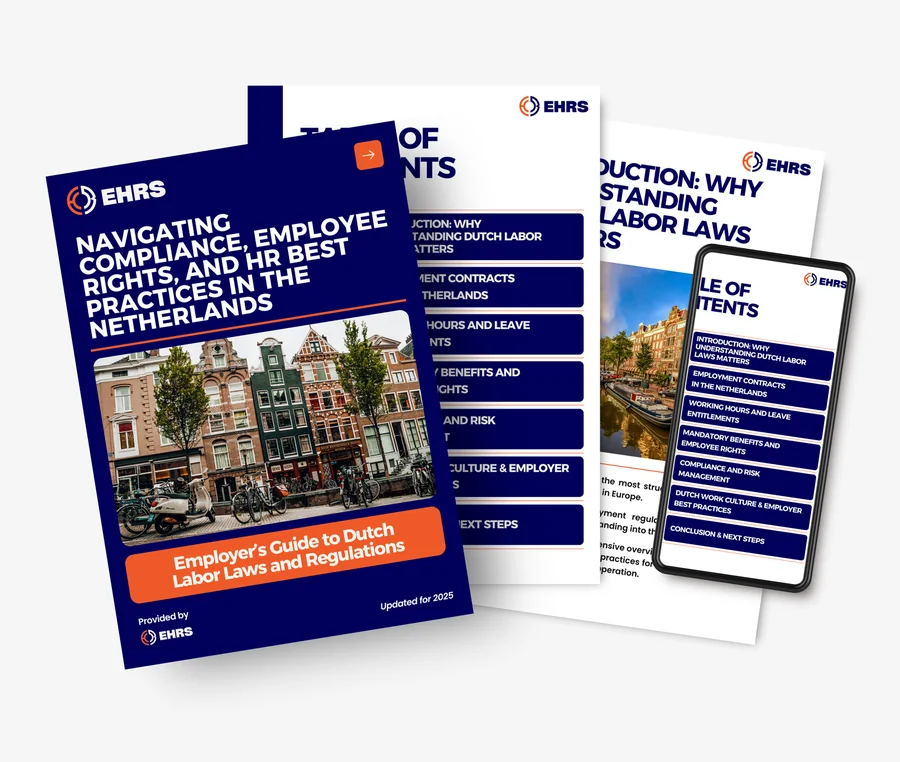
Navigating Compliance, Employee Rights, and HR Best Practices in the Netherlands
Employer’s guide to Dutch labor laws and regulations.
Want to read more first? See our HR and Compliance in the Netherlands guide.
Hiring in the Netherlands: Your Questions Answered
Questions companies ask before they hire in the Netherlands.
Do we need written employment contracts in the Netherlands?
You must give every employee the essential terms of the job in writing or electronically, such as the job, the place of work and the start date. A trial period is only valid if it is agreed in writing. We draft contracts that comply with Dutch law.
Can we let someone go in the Netherlands if they don’t work out?
During a valid trial period, yes, without giving reasons. It can last up to 1 or 2 months depending on the contract, and contracts of 6 months or less can’t have one. After that, a dismissal needs a reasonable ground and UWV permission, a court decision or a settlement agreement. We make sure your contracts include a clear trial period.
How much does an employee in the Netherlands cost on top of salary?
Non-wage costs, such as employer social contributions, add about 33% on top of gross wages (Eurostat, 2025). Also plan for a holiday allowance of at least 8%, paid leave and up to 2 years of sick pay at 70% or more. Our Compensation & Benefits Strategy builds a reward framework aligned with Dutch law, market data and internal equity.
How many hours can staff in the Netherlands work?
Adults can work up to 12 hours a shift and 60 hours a week, but no more than 48 hours a week on average over 16 weeks, with 11 hours’ rest in every 24. Employers must record the hours worked. We structure work schedules that comply and still leave room for flexibility.
What happens when an employee in the Netherlands is off sick?
You keep paying at least 70% of their wages for up to 2 years, and at least the minimum wage in the first year. You must also help them return to work, and you can’t dismiss them during those 2 years. We put clear sick leave policies in place.
How much paid leave do employees in the Netherlands get?
At least 4 times their weekly working hours, so 20 days on a five-day, 40-hour week, plus a holiday allowance of at least 8% of their wages. Days off on public holidays depend on the CAO or the contract. We keep you compliant with leave entitlements and help you offer a competitive benefits package.
Is it really that hard to terminate employees in the Netherlands?
It’s strict, not impossible. You need a reasonable ground and approval: UWV for economic reasons or long-term incapacity, the sub-district court for reasons such as poor performance, or a settlement agreement with the employee. If you end the contract, you also owe a transition payment of one-third of a month’s salary per year of service. We guide you through every step.
Can we keep staff on fixed-term contracts in the Netherlands?
Only up to a point. With gaps of 6 months or less, a fourth fixed-term contract, or a chain longer than 36 months, becomes permanent. Changes to these rules are scheduled for January 1, 2028. We make sure every fixed-term contract meets these rules.
Do collective agreements apply to us in the Netherlands?
A CAO applies if you are a member of the employers’ organization that signed it, or if the Ministry of Social Affairs and Employment has declared it binding for your sector. A CAO can also make a pension scheme compulsory. We keep you compliant with any agreement that applies, with as much flexibility as it allows.
Do we need a works council in the Netherlands?
Yes, once you employ 50 people or more. It has advice rights on major decisions and consent rights on changes to terms of employment, such as working times. With 10 to 50 people, you must set up staff representation if most employees ask for it. We guide you in setting up and working with a works council.
What does pay transparency mean for us in the Netherlands?
The Netherlands missed the June 2026 deadline for the EU Pay Transparency Directive. The government expects the new rules from January 1, 2027: no questions about previous salary, and regular pay gap reporting for employers with more than 100 employees. Our Compensation & Benefits Strategy covers EU Pay Transparency readiness.
What happens if we fail a labor inspection in the Netherlands?
The labor inspectorate (Nederlandse Arbeidsinspectie) can fine you up to €10,000 per employee for underpaying the minimum wage, and up to €12,000 per employee if you can’t prove wages, holiday allowance and hours worked. We conduct regular compliance audits so your documentation is ready for inspection.
Plan Your Dutch Expansion With an HR Specialist
Tell us about your plans for the Netherlands, whether it’s your first hire or a growing team. We’ll tell you honestly what we see.
- The Netherlands and 27+ European countries, through one team.
- No commitment, no generic pitch.
New to working with us? See how we work, from the first call to ongoing support.
What happens next: a senior consultant reads your message and replies within one business day to set up a short call.