
HR Services in Poland
HR support for US, UK and international companies hiring in Poland: Polish contracts and policies, payroll coordination, compliance and recruitment. Build your Polish team without building an HR department first.

Last reviewed October 2026. Collective agreements can set higher standards.
Expand Into Poland With an HR Partner Who Knows Polish Labor Law
Poland is the EU’s sixth-largest economy, grew 3.8% in 2025 against 1.4% for the EU, and has the EU’s fifth-largest population. It also brings detailed employment rules: written terms before the first day and further details within 7 days, notice that grows with service, a written reason for each dismissal outside probation, work rules and pay rules from 50 employees (20 if a union asks), and anti-bullying and anti-discrimination rules from 10 employees from November 5, 2026.
Europe HR Solutions is your HR partner for Poland. We prepare Polish contracts, policies and handbooks, put payroll foundations in place and coordinate your payroll provider, support hiring and reward, and review your HR practices as Polish law changes.
Expanding beyond Poland? The same team covers 27+ European countries, so you manage one relationship instead of a provider in every market.
On this page
Tell us about your plans for Poland. We’ll tell you honestly what we see.
Book a Free Consultation Free, no commitment.HR Outsourcing in Poland With Europe HR Solutions
One senior Europe HR Solutions team coordinates your HR in Poland, working with independent in-country HR professionals from our European network who understand Polish employment practice.
Everyday HR, handled
Payroll coordination, recruitment, compliance and employee relations for your team in Poland, handled as one service, so you can focus on growing the business.
Compliance with Polish labor law
We make sure your HR operations comply with Polish law, and review your contracts and policies as statutory rules and collective agreements change.
Cost-effective HR
Outsourcing means you don’t need your own HR team in Poland, which reduces cost and frees resources for growth.
Flexible engagement
We work ad hoc, on an interim basis, by project or on a retainer, from a few weeks to several years.
HR Services We Provide in Poland
Each of our services is available for Poland.
Compliant contracts, payroll registration and statutory foundations in place before your first Polish hire.
Employment Documentation Package→Polish contracts, policies and handbooks aligned with Polish labor law.
Systems & Payroll Coordination→Your HR systems and payroll providers aligned, with consistent data and full visibility for leadership.
Compensation & Benefits Strategy→A structured reward framework aligned with Polish law, market data and internal equity.
Recruitment Support→Roles calibrated, salaries benchmarked and hiring aligned with Polish employment law.
HR Compliance Audit→A structured review of your HR compliance risk in Poland, with a clear action plan.
Retained HR Services→Ongoing senior HR oversight on a monthly retainer, including manager coaching and support with works council interactions.
M&A HR Support→HR due diligence, employee transfer and post-deal integration for deals in Poland.
Key Employment Regulations in Poland
The Labor Code sets the baseline. A collective agreement, or your own work rules and pay rules, can add to it, so check both before you hire.
Show all 12 regulationsHide the regulations
Contracts and written terms (umowa o pracę)
Contracts are made in writing; if one isn’t, the employer must confirm its parties, type and terms in writing before the employee starts. Within 7 days of starting, employees must get details of working time, breaks, rest, overtime, leave and notice, on paper or electronically. A contract covers probation, a fixed term or an open-ended term.
Working hours and overtime
Basic system: 8 hours a day and 40 a week on average over up to 4 months (12 where justified), 48 on average with overtime, and rest of 11 hours a day and 35 a week. Overtime earns 50% extra, or 100% at night, on Sundays and public holidays off and over the weekly average, unless time off replaces it: hour for hour if the employee asks, 1.5 hours if not. Generally capped at 150 hours a year unless a collective agreement, work rules or the contract set another limit. Managers who run the workplace get no overtime pay and no 48-hour cap.
Minimum wage (minimalne wynagrodzenie)
PLN 4,806 a month for full-time employees since January 1, 2026, rising to PLN 4,950 on January 1, 2027. Allowances such as seniority, overtime and night-work pay don’t count toward it. Individuals on civil-law service contracts must, as a rule, get at least PLN 31.40 an hour, or PLN 32.30 from 2027. Collective agreements and pay rules can set more.
Paid leave and public holidays
20 working days a year, or 26 after 10 years of employment, counting previous jobs, up to 8 years of schooling for a degree and, at employers outside the public finance sector since May 1, 2026, documented self-employment and civil-law contract periods. Of 14 public holidays, 2 always fall on Sundays (Easter and Pentecost); a Saturday holiday cuts working time by 8 hours, giving staff another day off.
Sick pay (wynagrodzenie chorobowe)
The employer pays 80% of pay for up to 33 days a year, or 14 from the year after the employee turns 50, and 100% for illness in pregnancy or after a commuting accident. Social insurance then pays sickness benefit, usually 80%, paid out by employers with more than 20 insured staff and by ZUS for smaller ones.
Maternity, paternity and parental leave
Maternity leave is 20 weeks for one child, up to 6 before the birth; fathers get up to 2 weeks of paternity leave within 12 months. Parents share up to 41 weeks of parental leave, 9 reserved for each. Social insurance, not the employer, funds them: as a rule, 100% of the benefit base for maternity and paternity leave, 70% for parental leave.
Probation (okres próbny)
A separate contract of up to 3 months (up to 1 month before a planned fixed term under 6 months, 2 months before one of 6 to under 12 months, each extendable once by up to 1 month if the type of work justifies it). Notice is 3 working days to 2 weeks. Repeating it needs a different type of work.
Notice and dismissal (wypowiedzenie)
Notice depends on service with the employer, on fixed-term and open-ended contracts alike: 2 weeks under 6 months, 1 month from 6 months, 3 months from 3 years. The employer gives it in writing, with the reason and appeal rights, after notifying any company union representing the employee. An unjustified dismissal can mean reinstatement or 2 weeks’ to 3 months’ pay.
Employee representatives
A company trade union with at least 10 members has consultation rights, for example before notice to an employee it represents. With 50 or more employees, the employer holds works council (rada pracowników) elections if at least 10% of staff ask in writing, then informs and consults it. Organizations with 50 or more people working for them (any size in financial services) also need an internal whistleblowing procedure.
Social security (ZUS)
Non-wage costs, such as employer social contributions, make up 18% of total labor costs in Poland, or about 22% on top of gross wages (Eurostat, 2025). The employer must register each employee with the Social Insurance Institution (ZUS) within 7 days of the start of employment.
Employee Capital Plans (PPK)
PPK is a workplace savings plan that almost every employer must offer. You contract an approved financial institution and enroll each employee aged 18 to 54 after three months’ service; staff aged 55 to 69 join on request. Employees can opt out in writing, but opt-outs lapse every four years, next from April 1, 2027, when contributions restart unless they opt out again. You pay at least 1.5% of pay, up to 4% with a voluntary top-up; the employee pays 2%, or 0.5% on low pay; the state adds PLN 250 plus PLN 240 a year. Only micro-businesses where every employee opts out are exempt.
Pay transparency
Poland missed the June 7, 2026 deadline for the EU Pay Transparency Directive; the government plans to approve its draft law in the fourth quarter of 2026, and no bill was before the Sejm on October 22, 2026. Since December 24, 2025, candidates must get the starting pay or range in the job ad, or before the interview or hiring; employers can’t ask about pay history, and ads and job titles must be gender-neutral.
The Benefits of Expanding to Poland
What Poland offers companies that set up properly.
A top-six EU economy
Poland’s GDP was €923.5 billion in 2025, the sixth largest in the EU (Eurostat).
Strong growth
Poland’s economy grew 3.8% in real terms in 2025, against 1.4% for the EU (Eurostat).
A large home market
Poland had 36.3 million people on January 1, 2026, the EU’s fifth-largest population (Eurostat).
Exports
Polish goods exports reached €368.6 billion in 2025, 75% of them to other EU countries (Statistics Poland).
Strong school results
Poland ranks 14th of 139 economies for PISA scores in reading, math and science (Global Innovation Index 2026).
Diverse industry
Poland ranks 18th of 139 economies for domestic industry diversification (Global Innovation Index 2026).
The Challenges of Expanding to Poland
Six things to plan for before your first hire.
A written reason for dismissal
Dismissal notice on a fixed-term or open-ended contract needs a written reason; if unjustified, a court can order reinstatement or up to 3 months’ pay.
Employment costs
Non-wage costs add about 22% on top of gross wages (Eurostat, 2025), plus up to 33 days of employer-paid sick pay a year.
Fixed-term limits
Fixed terms with the same employee stop at 33 months or 3 contracts, then turn open-ended, with exceptions such as replacement or seasonal work.
Civil-law contracts under scrutiny
Since July 8, 2026, the labor inspectorate can declare a civil-law contract employment if its order to fix it is ignored; misuse carries fines of PLN 2,000 to 60,000.
Rules by company size
Work rules and pay rules from 50 employees (20 if the union asks) unless a collective agreement covers them; anti-bullying and anti-discrimination rules from 10 employees from November 5, 2026, adopted within 6 months.
Redundancy severance
From 20 employees, collective redundancies and dismissals solely for reasons not related to the employee cost 1 to 3 months’ pay, capped at 15 times the minimum wage.
Key HR Compliance Risks in Poland
Eight mistakes to avoid in Poland, and what each one leads to.
Civil-law contract instead of employment
A civil-law contract for work that is legally employment carries a fine of PLN 2,000 to 60,000, and since July 8, 2026, the labor inspectorate can reclassify it if its order to fix it is ignored.
Pregnant employee dismissed
During pregnancy and maternity, paternity or parental leave, notice is barred except on bankruptcy or liquidation, and summary dismissal needs the employee’s fault and the consent of any union representing the employee. The employee can claim reinstatement.
Terms not confirmed in writing
If the contract isn’t in writing, its terms must be confirmed in writing before the employee starts, or the employer faces a fine of PLN 2,000 to 60,000.
Fixed terms misused
A fourth fixed-term contract, or fixed terms over 33 months in total, become open-ended by law, unless an exception such as replacement or seasonal work applies.
Dismissal without a valid reason
If a court finds a notice unjustified or unlawful, it can reinstate the employee or award compensation of 2 weeks’ to 3 months’ pay.
Summary dismissal handled late
Dismissal without notice for the employee’s fault must happen within 1 month of learning the facts; otherwise the employee can claim reinstatement or compensation.
Work without a medical certificate
No employee can start without a valid medical certificate clearing them for the job; health and safety breaches carry fines of PLN 2,000 to 60,000.
Employee not reported to ZUS
Each employee must be reported to ZUS within 7 days of the start of employment; not reporting required data can be fined up to PLN 46,000.
Not sure where you stand? Our HR Compliance Audit gives you a structured review of your HR compliance risk in Poland, with a clear action plan.
Key Sectors in Poland
Poland’s leading export sectors in 2025, based on Eurostat trade data.
Free HR Guide for Poland
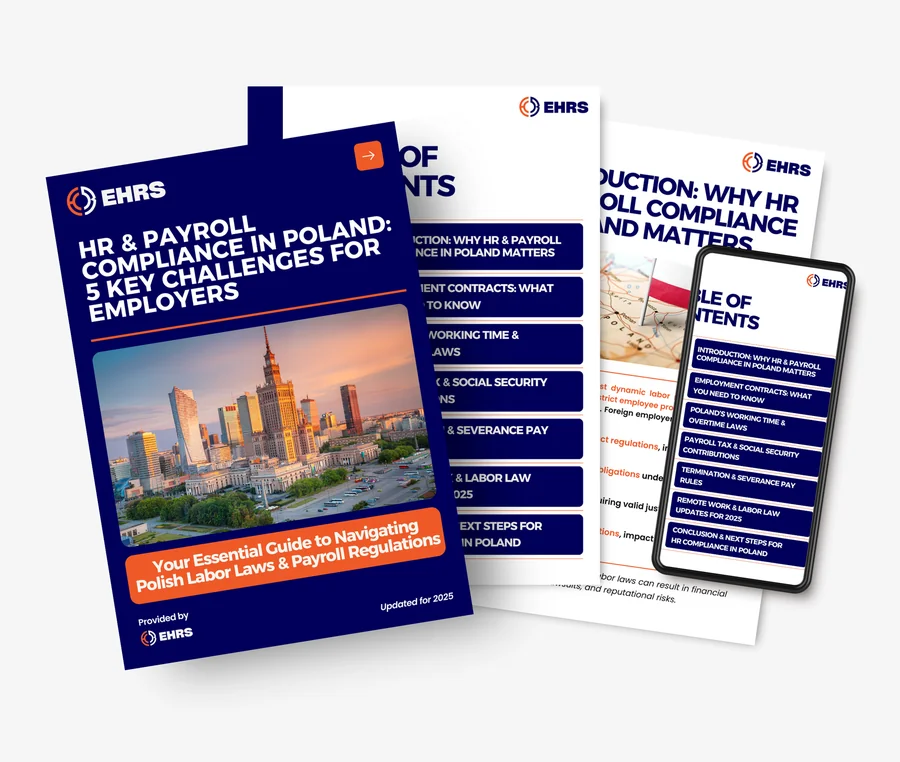
HR and Payroll Compliance in Poland: 5 Key Challenges for Employers
Your essential guide to navigating Polish labor laws and payroll regulations.
Want to read more first? See our article on HR and compliance in Poland.
Hiring in Poland: Your Questions Answered
Questions companies ask before they hire in Poland.
Do we need written employment contracts in Poland?
Yes. Contracts are made in writing; if one isn’t, you must confirm its terms in writing before the employee starts, or face a fine of PLN 2,000 to 60,000. Within 7 days, employees also get details of working time, leave, overtime and notice, and you register them with ZUS. We draft contracts that comply with Polish law.
Is there a probation period in Poland?
Yes: a separate contract of up to 3 months, or up to 1 month before a planned fixed term under 6 months and 2 months before one of 6 to under 12 months, the shorter ones extendable once by up to 1 month if the type of work justifies it. Notice during probation is 3 working days to 2 weeks. We make sure your contracts reflect these rules.
How much does an employee in Poland cost on top of salary?
Non-wage costs, such as employer social contributions, add about 22% on top of gross wages (Eurostat, 2025). Employers also pay sick pay for up to 33 days a year and, with 20 or more employees, 1 to 3 months’ severance in collective redundancies or dismissals solely for reasons not related to the employee. Our Compensation & Benefits Strategy builds a reward framework aligned with Polish law, market data and internal equity.
How many hours can staff in Poland work?
Basic system: 8 hours a day and 40 a week on average, 48 with overtime. Overtime earns 50% extra, or 100% at night, on Sundays and public holidays off and over the weekly average, unless time off replaces it. It’s generally capped at 150 hours a year unless a collective agreement, work rules or contracts set another limit. Managers who run the workplace get no overtime pay and no 48-hour cap. We structure work schedules that comply and still leave room for flexibility.
What happens when an employee in Poland is off sick?
The employer pays 80% of pay for up to 33 days a year, or 14 from the year after the employee turns 50, and 100% for illness in pregnancy or after a commuting accident. Then social insurance pays sickness benefit, usually 80%; employers with more than 20 insured staff pay it out, ZUS for smaller ones. We put clear sick leave policies in place.
How much paid leave do employees in Poland get?
20 working days a year, or 26 after 10 years’ employment, counting previous jobs, up to 8 years’ schooling and, at employers outside the public finance sector since May 1, 2026, documented self-employment and civil-law contract periods. Poland also has 14 public holidays; one on a Saturday gives staff another day off. We keep you compliant with leave entitlements and help you offer a competitive benefits package.
Is it really that hard to terminate employees in Poland?
It’s strict, not impossible. Notice runs 2 weeks to 3 months by service, on fixed-term and open-ended contracts, in writing with the reason, after notifying any company union representing the employee. Employers with 20 or more employees owe 1 to 3 months’ severance, capped at 15 times the minimum wage, in collective redundancies or when the only reason isn’t related to the employee. An unjustified dismissal can mean reinstatement or up to 3 months’ pay. We guide you through every step.
Can we put everyone on fixed-term contracts in Poland?
Not indefinitely. Fixed terms with the same employee are limited to 33 months and 3 contracts; beyond that, the contract is open-ended by law. Replacement, casual, seasonal and term-of-office work are exempt, as are fixed terms justified by the employer’s objective reasons, which must be notified to the labor inspectorate within 5 working days. We make sure every fixed-term contract meets these rules.
Do collective agreements apply to us in Poland?
Only if one covers you. A company agreement with your unions covers everyone working for you unless it says otherwise; a multi-employer agreement, made by employers or their organizations with unions, can be extended by the labor minister to employers covered by none. A separate act has governed them since December 13, 2025. Without one, employers with 50 or more employees (20 if the union asks) set work rules and pay rules. We keep you compliant with any agreement that applies, with as much flexibility as it allows.
Do we need employee representatives in Poland?
Not automatically. A company trade union with at least 10 members has consultation rights, for example before notice to an employee it represents. With 50 or more employees, staff can have a works council (rada pracowników) elected if at least 10% ask in writing; you must then inform and consult it. From 50 people working for you, you also need an internal whistleblowing procedure. We guide you in working with employee representatives.
What does pay transparency mean for us in Poland?
Poland missed the June 7, 2026 deadline for the EU Pay Transparency Directive, and the government plans to approve its draft law in Q4 2026. Since December 24, 2025, you must give candidates the starting pay or range in the job ad, or before the interview or hiring, use gender-neutral ads and titles, and not ask about their pay history. Our Compensation & Benefits Strategy covers EU Pay Transparency readiness.
What happens if we fail a labor inspection in Poland?
The National Labor Inspectorate (PIP) enforces labor law, including health and safety. Since July 8, 2026, offenses such as unpaid wages, working time breaches, missing written terms and misused civil-law contracts carry fines of PLN 2,000 to 60,000, and PIP can declare such a contract employment if an order to fix it is ignored. Converting pre-July 8, 2026 contracts by July 8, 2027 avoids the civil-law fine. We conduct regular compliance audits so your documentation is ready for inspection.
Plan Your Polish Expansion With an HR Specialist
Tell us about your plans for Poland, whether it’s your first hire or a growing team. We’ll tell you honestly what we see.
- Poland and 27+ European countries, through one team.
- No commitment, no generic pitch.
New to working with us? See how we work, from the first call to ongoing support.
What happens next: a senior consultant reads your message and replies within one business day to set up a short call.