
INHERITED HR RISK, MAPPED AND RANKED
HR Compliance Audit for Acquired Manufacturing Sites in Europe
Every European acquisition hands you plants, legal entities, and employment terms shaped by years of local practice that nobody fully documented. Our audit maps that inherited risk site by site and country by country, then tells you exactly what to fix before it turns into fines, employee claims, or a stalled integration.

THE RISK YOU INHERITED AT CLOSE
The Gap Every Acquirer Discovers
When a manufacturer acquires in Europe, the workforce arrives as-is. Contracts drafted under different local laws, payroll run by whoever the previous owner chose, shift and overtime practice shaped by years of plant-floor custom, and works-council relationships that never made it into the deal file.
None of this behaves like a legal abstraction. It surfaces one inconsistency at a time: a payroll run that does not match the contracts, a works-council question nobody saw coming, a severance clause that changes the cost of your restructuring plan.
The audit exists to get ahead of that sequence. It maps the risk you inherited, ranks it by severity, and tells you what to fix first, while the choices are still yours to make.
Years of Experience
27+
Countries

THE POST-CLOSE AUDIT, STEP BY STEP
How We Map an Acquired Workforce
Plant-Level Document Inventory
Step 1
-
Collection of contracts, collective agreements, and payroll registrations for every acquired entity
-
Review of shift, overtime, and working time practice against what the written terms say
-
A site-by-site record of what is actually in force, verified with local contacts
Inherited Liability Mapping
Step 2
-
Every finding anchored to the specific entity, site, and country it belongs to
-
Gaps weighed by how they affect operations, integration timing, and legal standing
-
A ranked picture of which acquired sites carry the most risk, and why
Remediation Sequencing
Step 3
-
Fixes ordered against your integration milestones, not a generic checklist
-
Items that must precede payroll changes, harmonization, or works-council consultations flagged first
-
A realistic sequence the integration team can actually run
Deal-Team and Board Reporting
Step 4
- Findings written for the integration PMO, General Counsel, CFO, and board
- A named owner and a place in the sequence for every action
- One document that serves integration planning and governance reporting alike
Over the past 15 years, we have served 250+ clients
WHAT THE AUDIT DELIVERS
What You Walk Away With
Scoped to your acquisition perimeter, from a single priority plant to every entity in the deal.
A site-by-site map of inherited employment and payroll risk
A remediation sequence tied to your integration milestones
Works-council and harmonization steps that proceed on solid legal ground
Reporting the PMO, General Counsel, and CFO can act on without translation
BUILT FOR ACQUIRERS
Who We Do This For
Manufacturers with newly acquired European plants
Closing or recently closed on European operations, inheriting entities and workforces across one or more countries.
Integration teams carrying inherited liability
HR integration leads, PMOs, General Counsel, and CFOs who own post-close workforce risk and need it mapped before it prices itself.

Start With the Sites That Worry You Most
SCOPED TO YOUR ACQUISITION
Three Ways to Scope the Audit

Tier 1: Priority-Site Audit
Focus where the integration clock is loudest:
- One country or a small set of priority plants
- Contracts, payroll setup, and working time practice at those sites
- Immediate red flags surfaced ahead of the next payroll run or consultation
For acquirers who need fast clarity on the riskiest part of the perimeter.
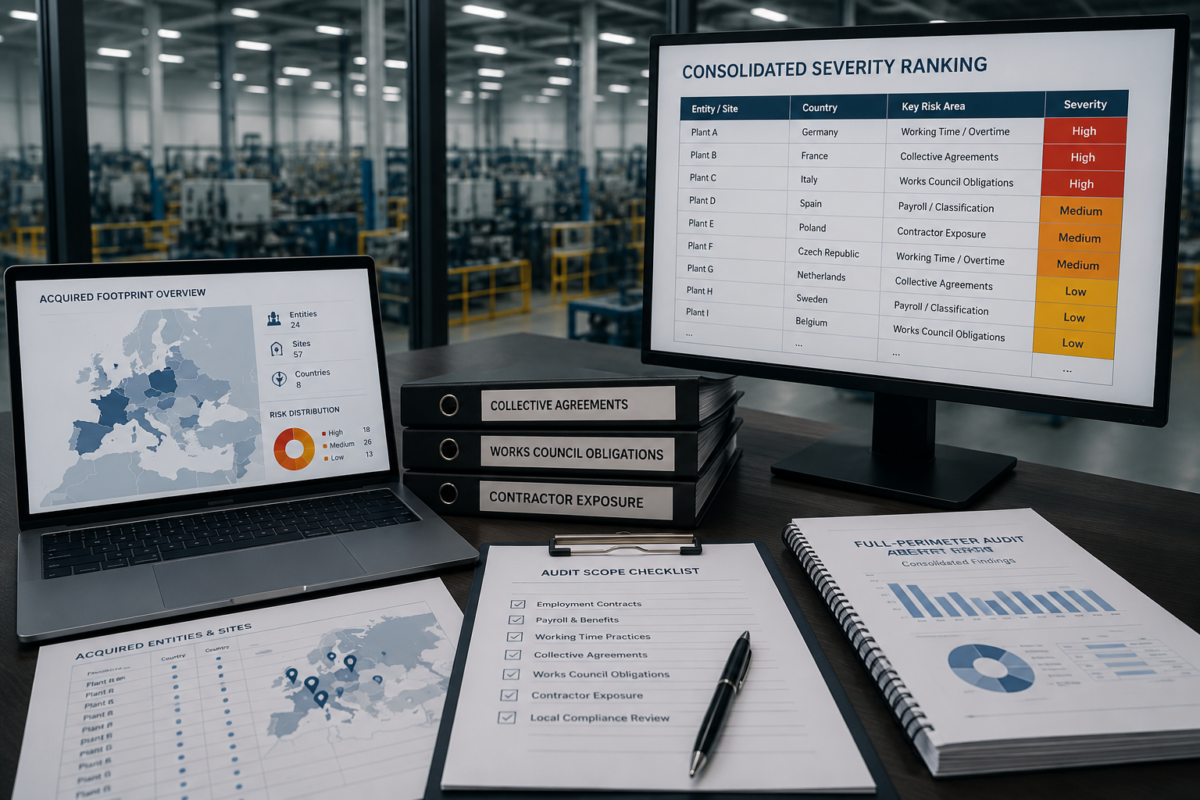
Tier 2: Full-Perimeter Audit
The complete acquired footprint:
- Every entity and site in the transaction, across all countries
- Collective agreements, works-council obligations, and contractor exposure included
- One consolidated severity ranking across the whole acquisition
For acquirers who need a single, comparable view before integration decisions.
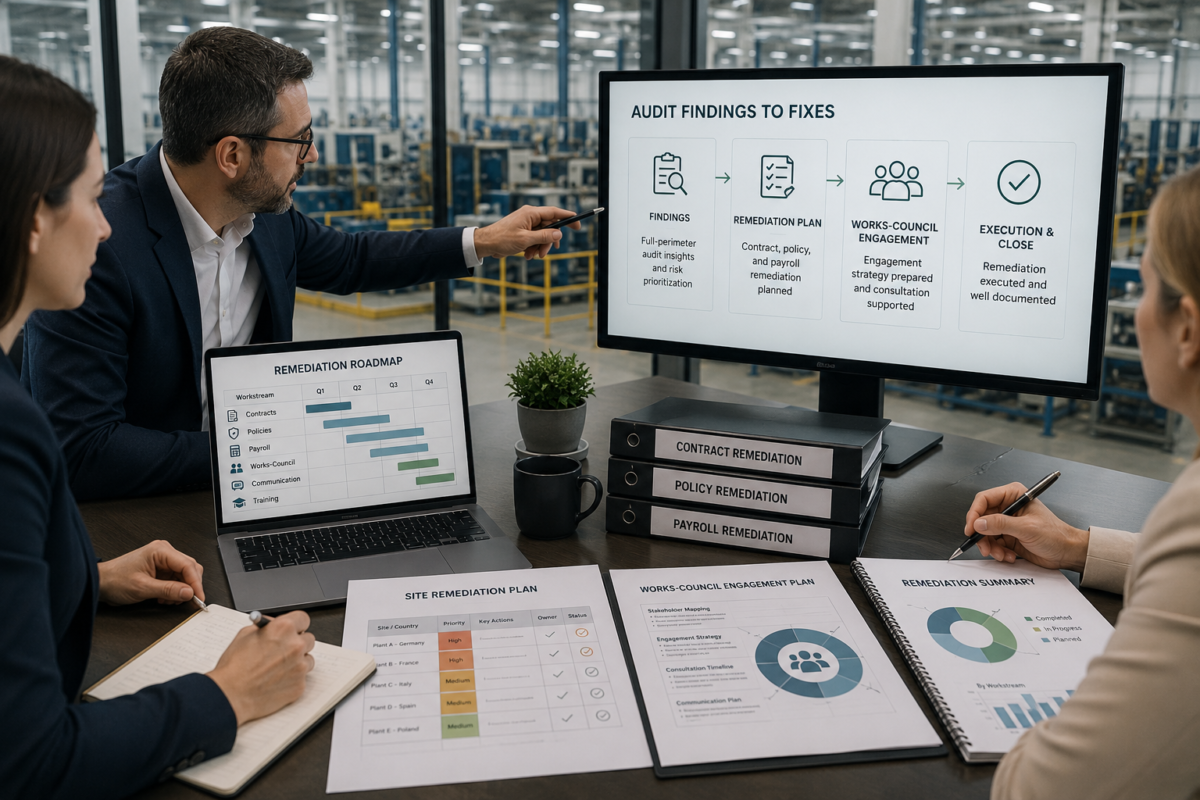
Tier 3: Audit Plus Remediation
From findings to fixes:
- Everything in the full-perimeter audit
- Contract, policy, and payroll remediation planned and carried out with your team
- Works-council engagement prepared and supported through consultation
For acquirers who want one team from mapping through execution.


TESTIMONIAL
From a Team That Inherited Europe
The tailored solutions and strategic advice from EHRS have been crucial in ensuring our European operations remain both compliant and agile. Their ability to integrate seamlessly into our projects and anticipate regulatory risk has made them a trusted and invaluable partner.

Chantelle Hilleard
Everbridge
Frequently Asked Questions For
Manufacturing Acquirers
1. What does the audit cover at each acquired site?
Everything the site actually runs on: employment contracts and templates, collective agreements and works-council arrangements, working time and shift practice, payroll registrations and statutory filings, temporary and agency labor, contractor classification, termination and disciplinary history, data protection in HR records, and pending claims, disputes, and inspection history. The same checklist is applied at every site, so findings are comparable across the whole acquisition.
2. We inherited works councils and collective agreements we have never dealt with. Where do we start?
Start by mapping what consultation rights exist at each site before making any integration move. In much of Europe, changes to roles, systems, working patterns, or structures trigger formal information and consultation duties, and the obligations differ by country and by agreement. The audit documents which bodies exist at each site, what they must be consulted on, and which parts of your integration plan will trigger them.
3. How do we know which acquired site needs attention first?
The audit ranks every finding by site and by country, weighing operational impact, integration timing, and legal standing. A misclassified contractor population at one plant and an outdated collective agreement at another are not the same problem, and they should not compete for the same budget on equal terms. The ranking tells you which one can wait and which one cannot.
4. Can we keep running the acquired sites on their existing terms while the audit runs?
Yes, and in most cases you should. Continuity of existing terms is usually the safer position immediately after close, and changing terms before you understand the obligations behind them can create new exposure. The audit runs alongside normal operations; what it changes first is your visibility, not your employees’ terms.
5. Are temporary and agency workers included?
Yes. Agency and temporary labor is a standing feature of manufacturing sites and one of the most common places inherited liability hides, from classification questions to equal-treatment obligations. The audit reviews how each site engages non-permanent labor and whether practice matches local rules.
6. What happens after the audit?
You receive a sequenced remediation roadmap with a named owner for every action. Many clients run the fixes internally from the roadmap; where support is needed, our employment documentation and retained HR services pick up specific workstreams.
Contact us for a
Free Consultation
Europe-HR-Solutions offers international and European HR expertise to companies that have acquired operations in Europe and need the inherited workforce brought onto compliant, documented foundations.
Consider this…
- Have you recently closed on a European acquisition, or are you about to?
- Are the acquired sites running on contracts and payroll practice you have not fully reviewed?
- Have works-council or collective-agreement questions started to surface during integration?
- Do your integration plans depend on knowing which acquired site carries the most risk?
- Do you need one partner to map and rank inherited HR exposure across every country in the deal?

Learn more about the services offered by Europe HR Solutions.